by Scott Keeter
Post-mortems on the election have rightly focused on a few big themes: the impact of the war, opinions about President Bush, and the strong Democratic performance among moderates and independents. But the shifting allegiance of some other important voter groups has gotten relatively less attention. One of the biggest stories is about young people. Another is what really happened to “The God Gap.” And a third is about the one-fifth of voters who aren’t white.
Young Voters Democratic for the Second Straight Election
Voters under 30 were John Kerry’s best age group in 2004, giving the Massachusetts senator 54% of their vote (Kerry did not win any other age group). The Democrats did even better among this age group this year, with Democratic House candidates getting 60% of the vote compared with 38% for Republican candidates. Democrats also won by wider-than-average margins in key Senate races such as Montana, New Jersey, Rhode Island, and Virginia.
Age and Congressional Vote, 2002-2006
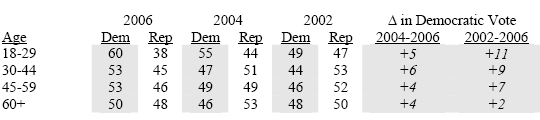
Sources: Exit polls conducted by VNS (2002) and NEP (2004, 2006). Votes for other candidates not shown.
And there are signs that this Democratic tilt among the young may be around for a while. While party affiliation among all voters was 38% Democratic and 35% Republican, the partisan balance among voters under age 30 was 43% Democratic and 31% Republican. In 2002, Republicans narrowly outnumbered Democrats among the young. Moreover, more young voters said they are liberal (34%) than said they are conservative (25%); among voters 30 and older, 33% identified as conservative and 18% were liberal. President Bush’s approval rating among young voters was just 34%, compared with 43% among the whole voting public.
Age and Party Affiliation, 2002-2006
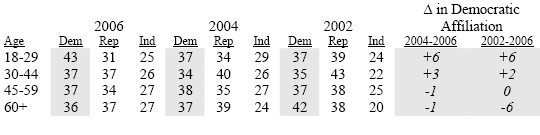
Sources: Exit polls conducted by VNS (2002) and NEP (2004, 2006).
No single issue stood out as especially important to young voters. Compared with other voters, fewer young voters rated corruption, immigration, Iraq, and terrorism as “extremely important.” Similar numbers of younger and older voters rated the economy and values issues as extremely important. Unlike older voters, however, younger voters who cited terrorism, immigration, and values issues actually voted Democratic in their choice for the House of Representatives.
Young voters were significantly closer to the Democratic Party on the issue of Iraq, with 63% saying they disapprove of the war in Iraq (compared with 57% overall), and more than two-thirds (68%) saying they favor the withdrawal of some or all American troops from Iraq (60% of voters overall take this position).
The exit poll suggests that many young voters were still in play as the campaign drew to a close. Nearly a third of young voters (31%) said they made up their minds about how to vote in the final days of the campaign, substantially more than among other voters (17%). Nearly two thirds of these late deciders voted Democratic.
The “God Gap” Widens
In recent years, some have asked whether the Democratic Party has a serious “God problem” – a growing inability to appeal to people of faith. But the result of this year’s election poses the question in a somewhat different way: Was the Republican Party hurt because it failed to appeal to voters beyond the traditionally religious? Exit polling found the Democratic Party’s gains concentrated among non-Christians and secular voters, suggesting that there was a larger political divide between Christians and the rest of American society.
The GOP held on to voters who attend religious services at least once a week (55% voted Republican versus 58% four years ago). But less frequent churchgoers were much more supportive of Democrats than they were four years ago. Among occasional churchgoers, 59% voted Democratic. In 2002, just 51% did so. And among those who never go to church, 67% voted Democratic — four years ago, only 55% did so. Thus, the gap in Democratic support between the most and least religious has grown from 16 percentage points in 2002 to 24 points today.
Congressional Vote by Worship Attendance, 2002-2006

Sources: 2006, 2004, and 2002 Exit polls
Religious voters were a key target of both parties. On the Republican side, white evangelicals have been the bedrock of the GOP throughout this decade — they constituted 35% of Republican voters on Election Day (and 38% of self-identified Republicans) — and many people wondered if the party’s troubles this year would hurt their prospects with this key voter group.
But the GOP actually did very well among white evangelicals: 72% voted Republican in races for the U.S. House nationwide, and they gave strong support — about two thirds or more — to Republican Senate candidates in several key states including Tennessee, Pennsylvania, Ohio, Missouri, and Virginia. These levels of support are comparable to those registered by evangelicals in 2004 and in 2002 (about 75% for Republican candidates).
Congressional Vote by Religious Affiliation and Frequency of Religious Attendance, 2002-2006
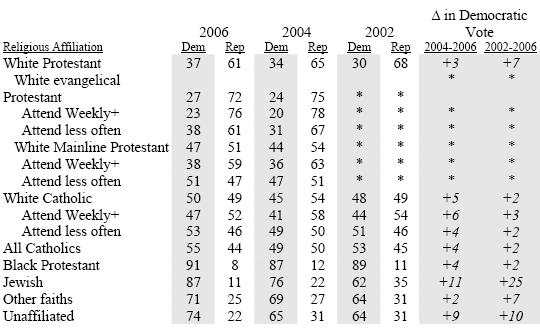
Sources: Exit polls conducted by VNS (2002) and NEP (2004, 2006). Votes for other candidates not shown. *The 2002 exit poll did not include a measure of evangelical identification.
And after see-sawing all year in the polls, President Bush’s approval rating among evangelicals on Election Day was 70%, far higher than in the general electorate. True, that was down 10 points from its level two years earlier, but the decline was no greater among evangelicals than among the rest of the electorate.
Evangelicals generally mirrored the rest of the public in the importance they attached to several key issues: Iraq, the economy, and interestingly, corruption and scandals. But while other voters who said corruption was extremely important voted heavily for Democratic candidates, two-thirds of white evangelicals who cited corruption voted for Republicans.
Evangelicals did split from other voters in the very high level of importance they attached to values issues such as gay marriage and abortion: 59% said these issues were “extremely important” to their vote. Just 29% of other voters said this.
Among another key religious group – Catholics – the House divided much as it did four years ago in 2002. Among all Catholics, the Democrats took a small majority of 55%, compared with 44% for the Republicans, aided by a strong 75%-24% margin among Hispanic Catholics. Among white Catholics — a key swing voter group — Democrats and Republicans divided the vote almost evenly (50% Democratic, 49% Republican). But these results represented virtually no gain for Democrats compared with 2002: white Catholics in 2002 also split their vote (48% Democratic, 49% Republican).
In fact, the Democratic Party’s gains came largely among non-Christians. Democratic House candidates gained 25 points among Jews and 7 points among those of other non-Christian faiths, compared with 2002. They also picked up 10 points among secular voters.
Race and the Vote
Hispanic voters gave Democratic House candidates a bigger share of their vote this year than in 2002 (69% vs. 61%), but the non-white vote overall was unchanged from four years ago: 76% Democratic in 2002, and 77% this year. Non-white voters made up a slightly larger share of the electorate this year: 21% did not identify as white or said they were Hispanic, compared with 19% in 2002.
The bigger story was the sharp rise in Democratic voting among whites. Four years ago, the Republicans beat the Democrats by a 58%-39% margin among white voters; this year, the parties split the white vote (47% Democratic, 51% Republican).
Nonetheless, black voters in particular were critical to Democratic successes in key races. In Ohio, 76% of blacks voted for Ted Strickland, the white Democratic gubernatorial nominee, against African-American Republican Kenneth Blackwell. A similar proportion of African-Americans in Maryland voted against the black Republican senatorial candidate, Michael Steele. Black voters also provided crucial margins for Jim Webb in Virginia and Claire McCaskill in Missouri (85% and 90%, respectively). In Tennessee, 95% of black voters chose Harold Ford, Jr., but that support was not enough to overcome the nearly 20-point advantage that Republican Bob Corker had among white voters.
Scott Keeter is Director of Survey Research at the Pew Research Center and an exit poll analyst for NBC News.